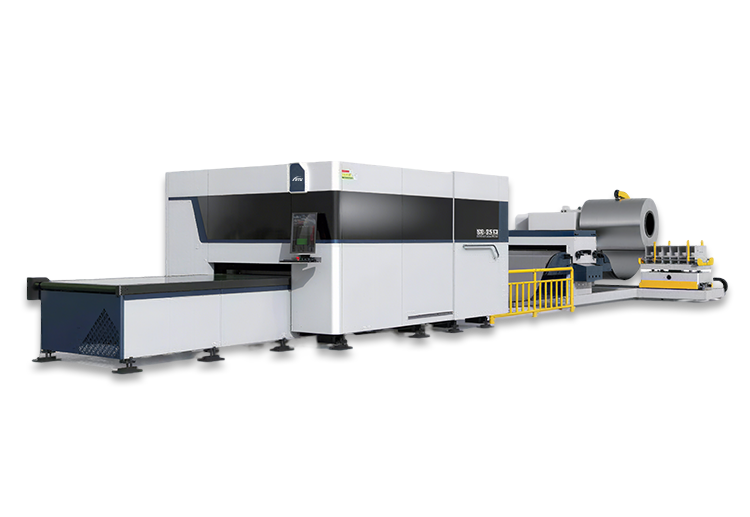
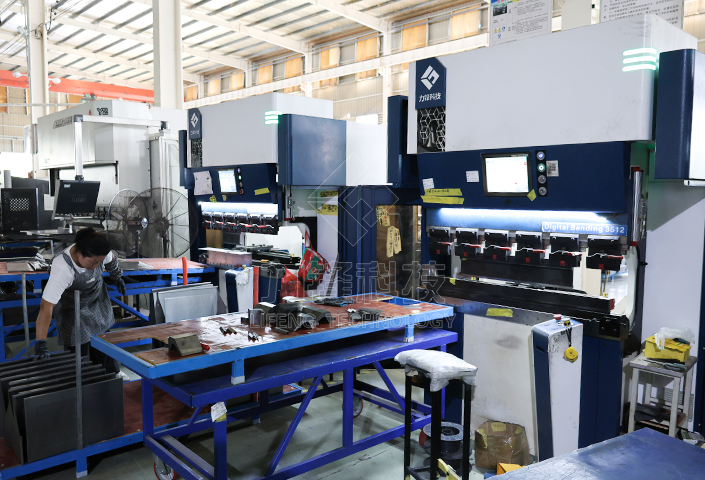
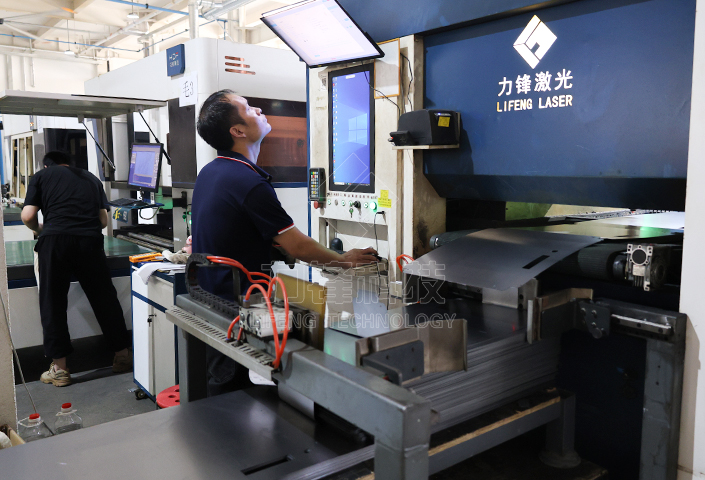
A single sheet goes in at one end of this workshop. At the other end, a finished stack of formed and welded parts comes off a pallet. In between, nothing is touched by hand: a robot picks blanks, a bending center forms them, a laser welds the seams, a second robot stacks the parts. The whole cycle in the clip runs under a minute per part.
Lines like this are no longer showroom pieces. They are being installed in ordinary subcontracting shops that could not fill a second shift, and in factories whose customers now order forty different parts instead of four. What follows is how the three stations actually divide the work, and where the savings come from.
Every automated cell has one bottleneck, and in most sheet metal setups it is the brake. A CNC bending center running a single part with six bends might take 40 to 70 seconds including handling. The loading robot has to present each blank at the right angle, hold it through the bend, rotate it for the next flange, and release without marking the surface. Vacuum grippers work well up to about 3 mm; magnetic grippers handle heavier plate but need a clean stack height.
Two details separate a cell that runs all day from one that stops every hour. First, angle compensation. Material thickness varies across a coil, and springback varies with it, so the control has to measure and correct instead of trusting a fixed table. Second, tooling changeover. If switching from one part number to the next means twenty minutes of die swapping, the cell loses the flexibility that justified the investment.
Welding a folded cabinet door or a chassis bracket is not the same job as welding a frame. The heat has to stay local or the panel distorts and the flatness you just paid for in the brake disappears. Laser welding puts far less heat into a narrow seam than a comparable MIG pass, which keeps distortion down and produces a bead that often needs no grinding before painting.
Speed is the other half of the argument. A fiber laser running a fillet at two to three metres per minute finishes a cabinet corner in a couple of seconds, and the robot spends most of its time moving, not welding. That is also why the welding center is easier to integrate than people expect: fixture design carries most of the engineering risk, not the process itself.
Stacking looks like the least technical job on the line, and it is the one most shops automate last. Then they count the hours. A palletizing robot that repeats a fixed pattern does not get tired at hour seven, does not dent the top panel putting it down, and does not need someone to re-count the stack at the end. It also gives you a clean handover to the next process: every pallet leaves with a known count, in a known orientation, ready for the welding line or the powder coating rack.
In the cell shown above, the palletizer is the reason the line can run through a break. Bending and welding can be watched by one person with a screen. Stacking cannot.
Research and Markets values the robotic sheet metal bending market at roughly USD 2.52 billion in 2026, heading for USD 3.95 billion by 2030 — about 11.9% annual growth. Two pressures explain it. Fabricators cannot find enough press brake operators, and their customers keep shrinking batch sizes while asking for the same delivery dates.
Automation answers the first problem directly and the second one only if it is set up for changeover, which is why we build cells around standard machines rather than one-off specials. If you send us a drawing set and your monthly volumes, we can tell you which parts belong in a cell and which are still cheaper to bend by hand.
Customized Production Line Design, Full-Lifecycle Service Guarantee From Solution to Implementation, Empowering Enterprises to Reduce Costs, Boost Efficiency, and Achieve Zero Risks!
Thank you for your interest in Lifeng Technology. If you would like to know more
about our sheet metal
process and equipment,
contact us to find out what we can do for your next project!

 lydia@lftk.cn